Bubble and Squeak with Fried Eggs
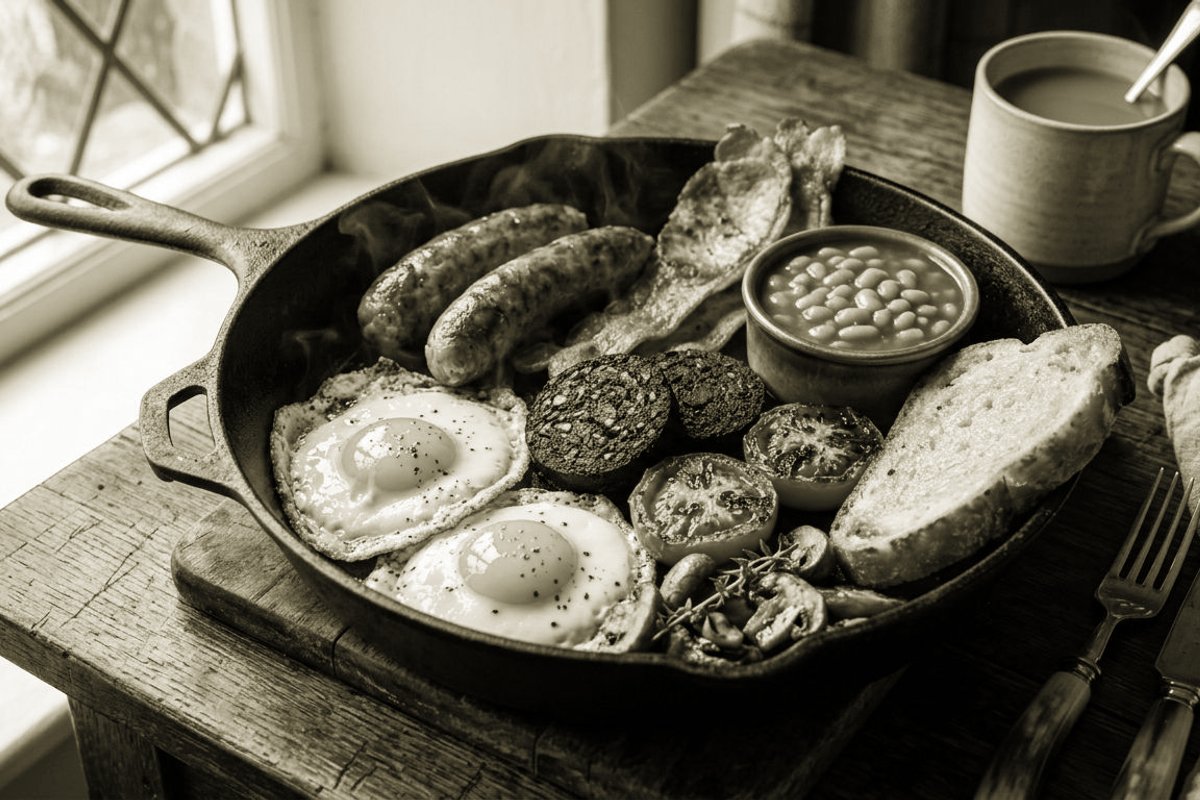
Doneness & Quality Checkpoints
- Cakes: 3 cm thick, chilled firm, dual crusts at medium-low, centre steaming hot throughout, at 75 °C for 30 seconds.
- Eggs: basted in the pan's accumulated fat, whites set, yolks running.
- Assembly: eggs draped, yolk broken at the table, worked into the crust.
Bubble and Squeak with Fried Eggs
Prep: 10 minutes · Cook: 25 minutes · Total: 35 minutes · Serves 2
Ingredients
The bubble cakes
- 500 g cold cooked floury potatoes, roughly mashed
- 250 g cold cooked cabbage or sprouts, squeezed very dry
- 30 g butter, softened, plus 30 g for frying
- 2 spring onions, sliced (30 g)
- 40 g mature Cheddar, grated (optional)
- 3 g fine sea salt
- 1 g black pepper
- 0.5 g grated nutmeg
The eggs
- 4 large eggs (220 g)
- 15 ml / 14 g neutral oil (to buffer the butter at egg heat)
To serve
- Brown breakfast sauce
- 2 slices (140 g) thick toast, or fried bread's last stand
- A grilled tomato half each (optional)
Instructions
- **Mix, shape, chill.** Combine the potato, cabbage, spring onion, butter, cheese, salt, pepper, and nutmeg until the mix holds when squeezed. Shape two 3 cm-thick cakes, pressing firmly. Chill 20 minutes. Checkpoint — each cake holds a clean edge and feels compact and firm; a thumb pressed in the centre leaves a slow-filling dent, not a crumble.
- **First crust — 8 minutes, undisturbed.** Heat the frying butter in a heavy pan over medium-low until foaming. Lay in the cakes and leave them entirely alone 7–8 minutes, until the undersides build a deep, continuous crust. Checkpoint — the edges show deep gold creeping up the sides, and a fish slide passes fully under each cake with crisp resistance — the feeling of a bonded crust, not a sticky base.
- **Flip and second crust — 6–7 minutes.** Flip each cake with a confident single turn (they are sturdier than the master's whole-pan version — one spatula does it). Add a small knob of butter (10 g) around the edges for the second face. Cook 6–7 minutes to a matching crust. Checkpoint — both faces deep golden, the sides showing no raw ring, and a cake is steaming hot throughout, with its centre held at 75 °C for 30 seconds on a clean probe — hot through, which matters more with a thick cake than a thin one.
- **The eggs in the same pan, 3 minutes.** Lift the cakes to warm plates. Add the oil and the last of the butter to the pan's residual fat and fry the 4 eggs over medium heat to the butter-basted master's spec — basting the hot fat over the whites until set, 2–3 minutes, yolks liquid. Checkpoint — set whites, lace edges, running yolks — and the eggs carry the pan's whole history: butter, crust fond, the faint sweetness of the cabbage's edges. The pan has seasoned its own sauce.
- **Landing — two eggs per cake, yolk broken at the table.** Two fried eggs draped across each hot cake, pepper over, sauce and toast alongside. The first cut breaks the yolks, and the eater works the yolk down into the crust's cracks with the fork's edge — the dish's ritual and its whole point. Checkpoint — the eating test: the crust crackles under the fork, the yolk disappears into its fissures, and every forkful from the first to the last carries egg, crust, and the soft cabbage-sweet middle. The plate is complete, and it was leftovers twelve hours ago.
Finish & Plate
Brown sauce at the side (its fruit-sharpness against the yolk's richness), toast to catch what escapes, and tea. This is the Monday plate that closes the Sunday roast's circle — the same cabbage, the same mash, transformed by a crust and an egg into a dish nobody calls leftovers.
Troubleshooting
| Symptom | Cause | Fix |
|---|---|---|
| Cake collapsed to hash under the eggs | Too thin or under-chilled | 3 cm, pressed firm, the full 20-minute chill |
| Crust tore at the flip | Turned early or wet mix | The full 8 minutes; squeeze the cabbage harder |
| Yolk cooked before the cake's second side | Sequencing inverted | Cakes finish first and hold warm; eggs always last |
| Centre cold | Thick cake rushed | Medium-low; check the centre is steaming hot throughout and hold at 75 °C for 30 seconds |
Storage, Make-Ahead & Variations
- **Refrigerate the mix and use within 2 days of originally cooking the ingredients** and shaped cakes freeze 2 months (cook from frozen, +4 minutes a side at lower heat). Cook until steaming hot throughout and serve straight away; leftovers used in the mix should be reheated only once. - **Variation — the Benedict bridge:** one poached egg and a spoon of the blender hollandaise replaces the fried eggs — the bubble-and-squeak eggs benedict's whole idea in a sentence. - **Variation — the ham pocket:** press 50 g of chopped leftover ham into each cake's centre at shaping — the roast dinner's full inventory, enclosed. - **The loop:** this record, the master, the cakes, and the benedict are one dish in four forms — the fridge's context decides which one you are cooking.