Crispy-Edged Fried Eggs
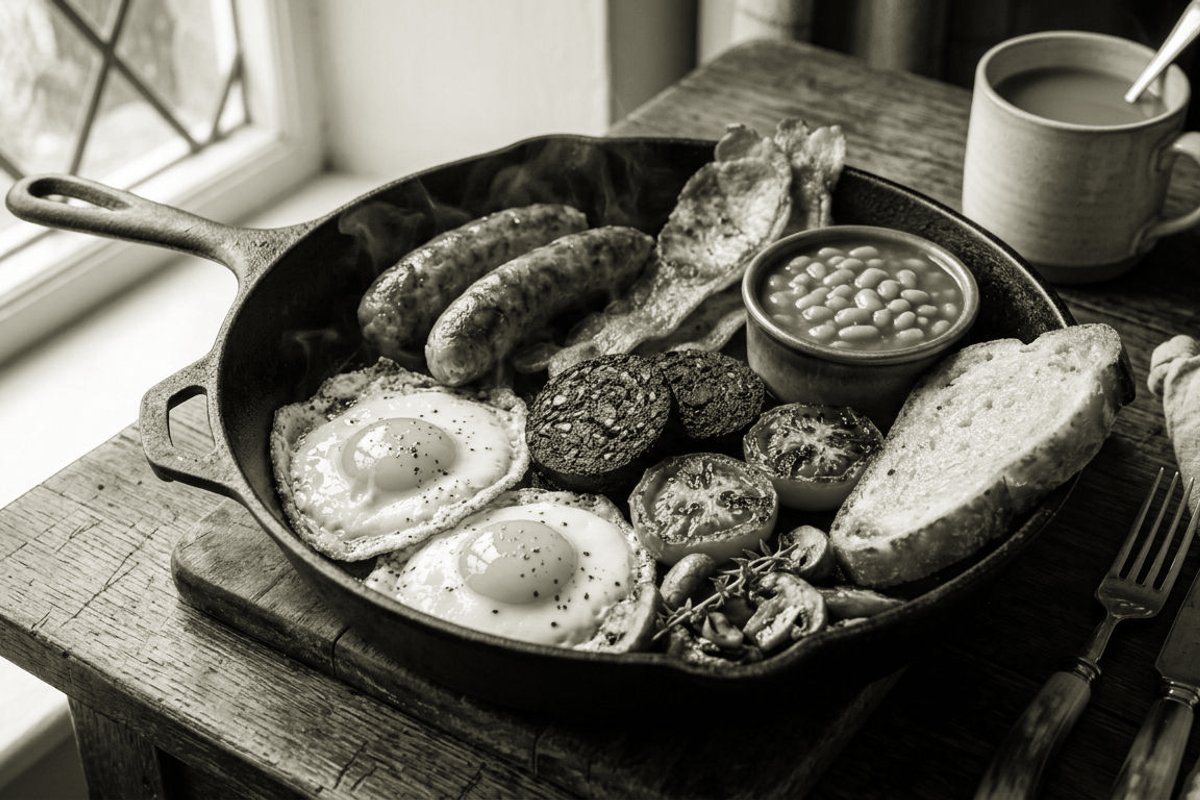
Quantities live in the recipe card.
The eggs and fat
- better — the rendered fat strained off a full English's bacon
To serve
Crispy-Edged Fried Eggs
Prep: 2 minutes · Cook: 3 minutes · Total: 5 minutes · Serves 2 (4 eggs)
Ingredients
The eggs and fat
- 4 large eggs (220 g), at room temperature
- 45 ml / 40 g neutral oil, or — better — the rendered fat strained off a full English's bacon
- 1 g fine sea salt
- 0.5 g freshly cracked black pepper
To serve
- 4 slices (about 200 g) thick white bread, toasted, or the components of your fry-up
Instructions
- **Heat the pan to a genuine medium-high.** Add the oil and give it 2 minutes. The oil should shimmer and thin out — a drop of egg white introduced to the pan should sizzle violently and bubble at once, not whisper. Checkpoint — the oil shimmers with faint movement across its surface, and a drop of egg white sizzles loudly within a second of contact. If the white just sits there quietly, the pan is 30 seconds away — wait.
- **Drop the eggs and hold the temperature.** Slide each egg from its cup into the oil, spacing them apart. The thin outer white will spread and immediately begin bubbling and frying at its edges. Do not touch them. Do not shake the pan. Let the oil do the work — 60 to 90 seconds for lace-edged, up to 2 minutes for deep bronze lace. Checkpoint — the outer white has turned golden-brown and lacy at the edges — a crisp mesh that crackles faintly when the pan is tilted — while the main body of the white is fully opaque and set, and the yolk still trembles. This is the architecture: lace, yield, run.
- **Drain briefly and serve at once.** Lift each egg out with a fish slice, let the excess fat drip off for 3 seconds, and land it on the toast or the plate. Salt and pepper now, while the lace is still crackling. Checkpoint — the first forkful gives you the edge's shatter, then the white's yielding, then the yolk's run — three textures in sequence. If the edge has gone soft, the egg waited too long; it holds for no one.
Troubleshooting
| Symptom | Cause | Fix |
|---|---|---|
| No crispy edge, just a flat set white | Oil too cool or too shallow | Genuine medium-high and 2–3 mm of fat; the edge needs to *fry*, not set |
| Edges brown, inner white still raw | Heat too high for the egg's size | 15 seconds lidded, heat off, to steam-finish the top |
| White scattered across the pan | Egg cracked straight into hot oil | Cup first, every time; lower the egg close to the surface |
| Yolk breaks on landing | Egg dropped from height | Slide from the cup held just above the oil |
| Greasy, heavy egg | Undrained | 3 seconds' drain on the fish slice before plating |
Storage, Make-Ahead & Variations
- **These do not hold.** A crispy egg is a ninety-second egg eaten in the next ninety seconds — the lace softens within minutes under its own steam. Time them to land last on the plate. - **Fat choice:** bacon fat strained from the fry-up's earlier components is the house choice — it carries the smoke of the breakfast behind it. Neutral oil is the clean-canvas option; butter alone burns at this heat and is better saved for the basted version. - **Variant — the "clipped" egg:** for a neat round egg on a bap or muffin, drop the egg into a 9 cm greased egg ring; the lace forms inside the ring's wall. Pull the ring at 60 seconds with tongs. - **Serving math:** one egg per slice of toast, two per hungry person, three for the builder who's been on the roof since seven.