Homemade Tomato Ketchup
Quantities live in the recipe card.
The tomatoes
The aromatics
The vinegar and spice
To finish
- check it is vegetarian if it matters to your table
Doneness & Quality Checkpoints
- Reduction: half the volume, brick-red, ribbon stage on the spoon.
- Texture: blended to a gloss, no seed flecks (sieved if perfectionist).
- Balance: sweet → acid → spice in sequence, savoury-forward.
- Bottled hot into sterilised glass; lid sealed on cooling.
Homemade Tomato Ketchup
Prep: 20 minutes · Cook: 1 hour 15 minutes · Total: About 1 hour 45 minutes, plus cooling · Makes about 500 ml
Ingredients
The tomatoes
- 1.5 kg ripe plum tomatoes (about 12–14), roughly chopped, or 2 × 400 g tins whole plum tomatoes plus 200 g fresh cherry tomatoes
- 50 g tomato purée (about 3 tablespoons)
The aromatics
- 1 medium onion (150 g), finely diced
- 1 garlic clove, crushed
- 15 g fresh ginger, peeled and grated (optional but recommended)
- 30 ml / 28 g olive oil
The vinegar and spice
- 150 ml cider vinegar (or 120 ml malt vinegar for a sharper, more traditional bite)
- 70 g soft light brown sugar
- 3 g fine sea salt, plus more to season
- 1 tsp (2 g) ground allspice
- 1 tsp (2 g) smoked paprika
- ½ tsp (1 g) ground cloves
- ½ tsp (1 g) celery salt
- ¼ tsp (0.5 g) cayenne pepper
- 1 bay leaf
- 6 black peppercorns
To finish
- 1 g ground white pepper
- Worcestershire sauce (about 10 ml, 2 teaspoons) — check it is vegetarian if it matters to your table
Instructions
- **Sweat the aromatics.** Warm the oil in a wide, heavy-based pan over medium-low heat. Add the onion with a pinch of salt and cook 8–10 minutes until soft and translucent but not browned — a pale, sweet base. Add the garlic and ginger for the final 1 minute. Checkpoint — the onion has fully slackened, the garlic smells sweet rather than sharp, and the pan smells savoury with no scorched edge.
- **Bloom the spices.** Stir in the allspice, paprika, cloves, celery salt, cayenne, and a good grind of black pepper. Cook 60–90 seconds, stirring constantly, until the spices darken a shade and smell toasted. Checkpoint — the spices have turned fragrant and the oil has taken on a rusty colour; nothing has caught or gone bitter. This is a brief stage — count it out if you need to.
- **Build and simmer.** Add the tomatoes, tomato purée, vinegar, sugar, salt, bay leaf, and peppercorns. Bring to a gentle simmer, then turn the heat to the lowest flame that keeps a lazy bubble going. Simmer uncovered 50–70 minutes, stirring every 10 minutes and more often toward the end, until the volume has reduced by about half and the sauce darkens from bright red to deep brick-red. Checkpoint — the sauce mounds briefly on a spoon before slowly settling, the surface leaves a clear trail when a spatula is dragged across the pan base, and the colour has deepened two shades darker than it started.
- **Blend smooth.** Fish out the bay leaf. Blend the sauce until completely glossy and smooth — 2–3 minutes with a stick blender, longer than feels necessary; the texture should be velvety with no flecks. Push through a fine sieve for a factory-gloss finish (worth it once; optional thereafter). Checkpoint — the blended sauce coats a spoon with no visible tomato skin or seed fleck and reflects light.
- **Final seasoning — the balance pass.** Return the sauce to a low heat and add the white pepper and the Worcestershire sauce. Taste and adjust the triangle: a pinch more salt for depth, a teaspoon of vinegar for sharpness, a teaspoon of sugar only if the tomatoes were lean. Simmer 5 minutes more, then cool 15 minutes. Checkpoint — on a spoon, the sauce hits sweet first, acid second, then a low hum of spice — no single note dominating. It should taste distinctly more savoury and less sweet than bottled ketchup.
- **Bottle hot.** Pour the sauce into the sterilised bottle or jar while still warm, leaving 1 cm headspace, and seal immediately. Cool completely, then refrigerate. Checkpoint — the sealed bottle, once cooled, gives a faint "pop-click" of the lid being drawn down (or a solid, unmoving lid) — the sign of a proper hot-fill.
Finish & Plate
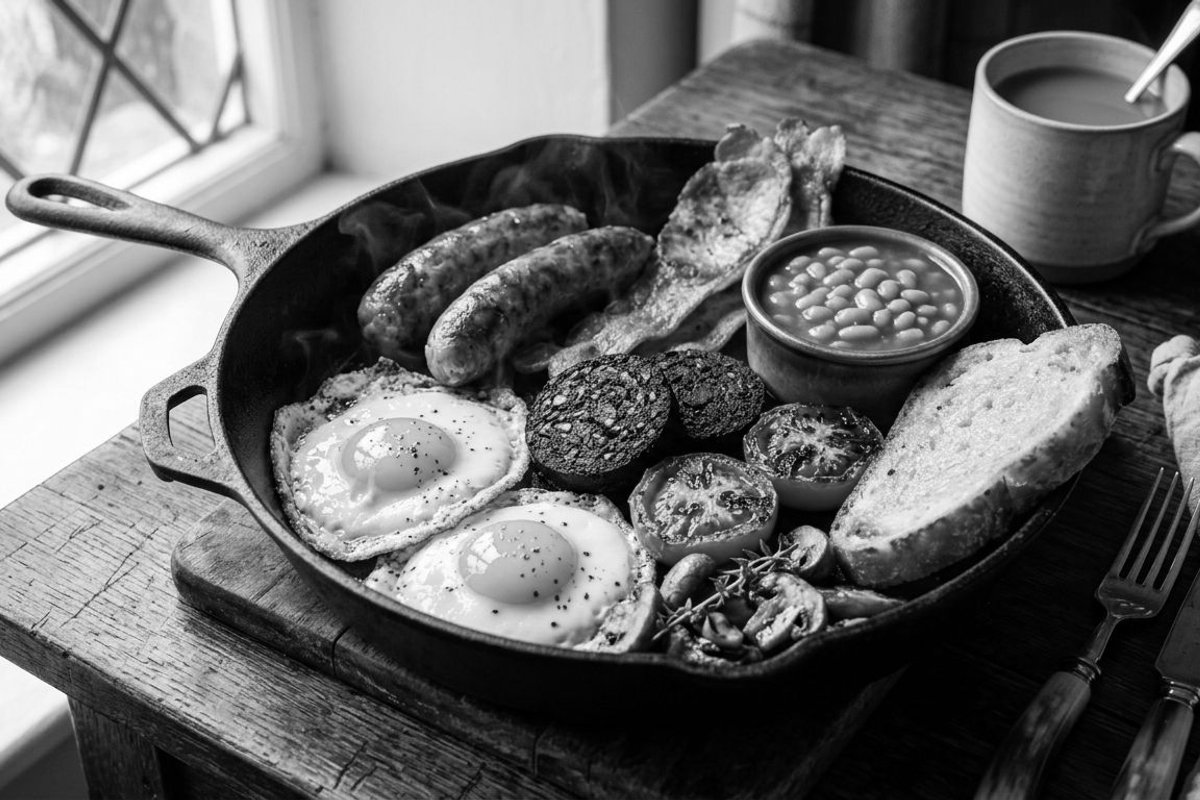
Serve at breakfast beside the butter-basted fried eggs, on the bacon butty where its lower sweetness lets the bacon lead, or — the café classic — as the dipping sauce for hash browns and fried bread soldiers. On the proper fry-up plate it stands in its small dish beside the brown breakfast sauce, and regulars take a spoonful of each. It also earns its keep at dinner: a spoonful glazes sausages mid-roast and sharpens gravy.
Troubleshooting
| Symptom | Cause | Fix |
|---|---|---|
| Sauce bitter | Spices burnt, or reduction too hot, too fast | Lowest simmer only; bloom spices 60–90 seconds max |
| Too thin, even after long simmering | Lid never came off, or watery tomatoes | Uncover fully; simmer 10 more minutes at a time — or cheat with 1 tsp cornflour slurry at the end |
| Too vinegary | Malt vinegar heavy hand, or added all at once | More sugar, 20 g at a time, plus 10 more minutes' simmering |
| Tastes flat despite good texture | Under-salted | Salt lifts tomato more than sugar does — add 1 g at a time |
| Fermented or fizzed in storage | Unsterilised jar or under-vinegar sauce | Sterilise properly; keep refrigerated; this is a fresh sauce, not a shelf-stable preserve |
Storage, Make-Ahead & Variations
- **Storage:** refrigerate up to 4 weeks. Always use a clean, dry spoon — the sauce's vinegar and sugar preserve it only against clean handling. Freeze in ice-cube trays for portioned uses, up to 6 months. - **Variation — smoky café ketchup:** double the smoked paprika and add 5 ml of the brown breakfast sauce to the final blend; deepest version for bacon butties. - **Variation — spiced breakfast ketchup:** add ½ star anise and a 5 cm cinnamon stick with the bay leaf for the full simmer; lift before blending. Warming, almost chutney-adjacent. - **The batch cook:** the sauce keeps 4 weeks — make it a fortnight before a big breakfast and it improves in the bottle as the flavours marry.