Proper Café Fry-Up
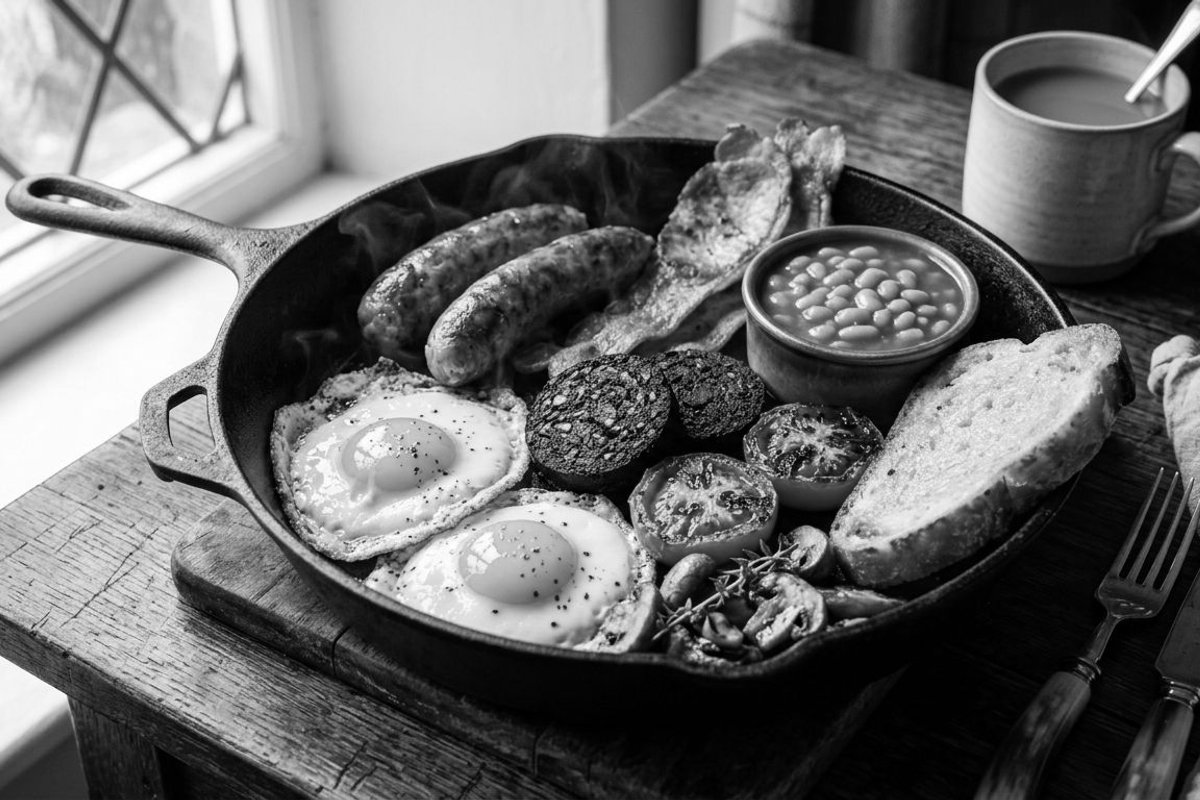
Quantities live in the recipe card.
The works, café portions
- the caff's default, pressed flat
Fat and seasoning
- the bottles, to serve
Doneness & Quality Checkpoints
- Sausages: all-four-sides brown, once-pricked, clear juices.
- Bacon: pressed flat at contact; glassy amber fat, uncurled.
- Fried bread: taken early enough to stay bread, not crouton.
- Eggs: basted, lace-edged, running yolks; plate assembled hot with zones respected.
Proper Café Fry-Up
Prep: 10 minutes · Cook: 25 minutes · Total: 35 minutes · Serves 2
Ingredients
The works, café portions
- 4 pork sausages (320 g), pricked once each
- 4 rashers (200 g) unsmoked back bacon — the caff's default, pressed flat
- 4 thick slices (200 g) black pudding
- 4 large eggs (220 g)
- 2 slices (100 g) thick white bread, for fried bread
- 200 g baked beans (half a tin)
- 1 large tomato (150 g), halved, or 100 g tinned plum tomato, drained (the winter caff option)
- 100 g button mushrooms, whole if small
Fat and seasoning
- 15 ml / 14 g neutral oil, to start
- 15 g butter
- 3 g fine sea salt
- 1 g white pepper (the café's quiet signature)
- 15 ml milk or 10 g butter, for the beans
- Brown breakfast sauce and tomato ketchup sachets' honest superiors — the bottles, to serve
- Strong builder's tea, to drink
Instructions
- **Sausages hot, 8–10 minutes.** Film the pan with the oil over medium-high heat and lay in the sausages. Cook 8–10 minutes, turning every 2–3 minutes to brown all four sides, dropping the heat to medium after the first turn. Checkpoint — deeply browned on every face, skins taut (one pin-prick vent), juices running clear at a nick. The pan holds its first slick of rendered fat — the fry's first currency.
- **Fried bread — the fat's first dividend, 3 minutes.** Lay the bread straight into the pan's fat, pressing it flat with the spatula so it drinks evenly. Fry 90 seconds a side until deep gold and crisp-edged, then lift to the warm plate. Checkpoint — the bread is evenly golden, crisp at the surface but still faintly yielding within — fried bread, not a crouton. Any fat left in the pan stays; the bacon needs it next.
- **Bacon flat, 5 minutes.** Lay the bacon rashers in the hot fat and immediately press them flat with the spatula for 10 seconds — the caff's trick against curling. Cook 2–3 minutes until the underside renders glassy-gold, flip, and cook 2 minutes more. Add the black pudding slices and mushrooms to the pan's free space for the last 4 minutes, turning the pudding once and the mushrooms as they brown. Checkpoint — the bacon is flat, its fat glassy and amber, the eye just-set and juicy; the black pudding is dark-crusted both faces, holding firm; the mushrooms have browned and glossed in the accumulated fat. The tomato halves go cut-face down for the final 2 minutes, just to blister and heat.
- **Eggs basted, 2–3 minutes — the fry's finale.** Clear the pan's centre (cooked items rest at the edges or join the warm plates), add the butter to the fat, and crack in the eggs when it foams. Cook 90 seconds, tilting the pan and spooning the hot fat over the whites repeatedly, until the whites set with lace edges and the yolks stay liquid. Checkpoint — whites fully set — top and bottom — with golden frilled edges, yolks domed and running. Basted eggs are the café egg: no flipped yolk-cracking risk, no lid-sogginess, one pan's worth of fat doing all of it.
- **The plate — assembly in the caff's order.** Beans first, poured to one side of each hot plate (their sauce must not meet the egg). Then, clockwise from twelve: egg, bacon crossed, sausages, black pudding, mushrooms, tomato, and the fried bread propped at the edge. White pepper over the eggs — the café's quiet signature — and the sauce bottles on the table. Checkpoint — the plate at arm's length reads as *a proper fry-up* — full, browned, separated zones, yolk intact; and every component is still at eating temperature because the plates were hot and the sequence was fast.
Finish & Plate
The full works with builder's tea — strong, milky, the mug refilled before asked. Brown sauce for the bacon and fried bread, ketchup for the sausage, and the fork worked from the egg outward, each component dipped or dragged through its proper sauce. This is the plate eaten standing at the counter or sitting at the window, in under ten minutes, entirely without regret.
Troubleshooting
| Symptom | Cause | Fix |
|---|---|---|
| Bacon curled and ridged | No press at contact | The 10-second flat press, immediately |
| Fried bread greasy and heavy | Pan's fat too deep or bread left too long | 90 seconds a side; pour off excess fat first |
| Sausages burst and grey | Pricked repeatedly or heat spiked | One prick, medium after the first turn |
| Everything tepid by plating | Cold plates, slow sequence | Plates in the oven from minute one; the fry's pace is part of the recipe |
| Beans developed a skin or rubbery edge | Microwaved | Small pan, splash of milk, gentle simmer, stir once |
Storage, Make-Ahead & Variations
- **The caff doesn't do make-ahead, and neither does this plate** — it is a 35-minute, eat-immediately dish by design. Components keep 3 days refrigerated if leftovers insist on existing; the eggs never do. - **Variation — the "number 4" plate:** any café's menu is this master with components subtracted — two eggs, bacon, sausage, beans, fried bread is the most-ordered plate in Britain. The sequencing holds for any subset. - **Variation — the large plate ("the works plus"):** add a slice of fried bread and a second egg; the pan's sequence stretches by 3 minutes at the egg stage only. - **The griddle upgrade:** a cast-iron double-burner griddle run hot at one end and cooler at the other is the honest home replica of the caff's two-temperature system, and turns this recipe from skilled into easy.